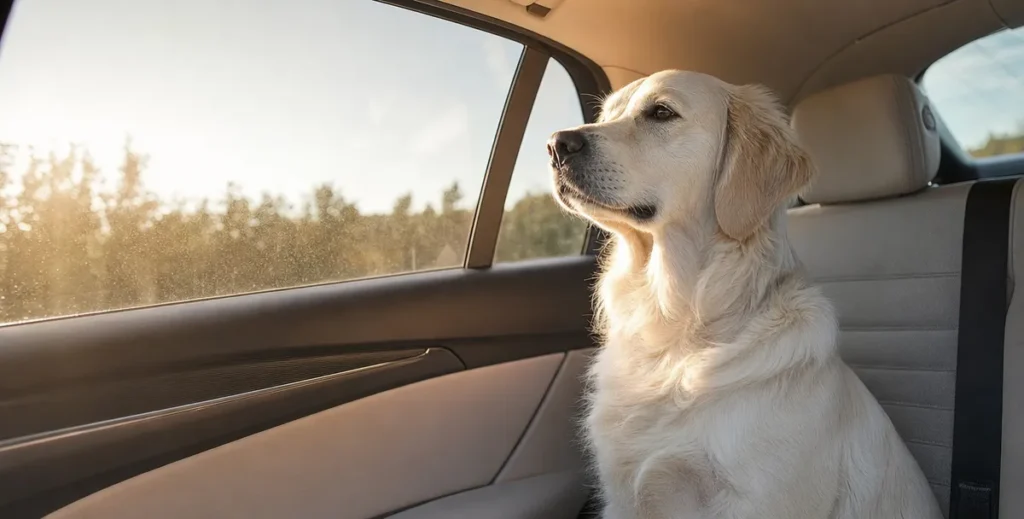
Quick question: does your dog ride shotgun a lot? Or hang out by the back window on drives?
If so, here’s something most people never think about — car windows don’t actually block all the sun. Some of it gets through, every single ride, even with the windows closed.
The Windshield Is Good. The Side Windows? Not So Much.
Not all car glass is the same.
The front windshield is made with a plastic layer sandwiched between two sheets of glass. That layer is really good at blocking UV. In a 2016 study published in JAMA Ophthalmology, Dr. Brian Boxer Wachler tested 29 vehicles from 15 manufacturers and found windshields blocked an average of 96% of UVA rays (the type linked to long-term skin aging and damage), with individual vehicles ranging from 92–99%.
Side windows told a different story. Same study, same cars — side windows blocked an average of just 71% of UVA, with some vehicles as low as 44%. Side and rear windows are usually a single sheet of tempered glass, with no plastic layer inside. They still block nearly all UVB. But that UVA gap is real, and it’s a lot more sun getting through than most people assume.
There’s Already Evidence This Adds Up Over Time
In 2012, a case published in the New England Journal of Medicine made this pretty hard to ignore. A 69-year-old truck driver had spent nearly three decades behind the wheel. The left side of his face — the side closest to his window — looked noticeably older than the right. Thicker skin, deep wrinkles, visible sun damage. The right side barely showed any.
He never got sunburned through the glass. That’s the part that surprises people — UVB (the “burning” ray) mostly gets blocked. It was UVA, quietly getting through year after year, doing damage that doesn’t show up as redness or pain. Just slow, invisible wear.
That case is about a person, not a dog — worth being upfront about that, since dog skin and coat structure are pretty different from ours. There aren’t comparable long-term studies in dogs. What we can say with confidence is narrower: the physical properties of UVA transmission through glass don’t change based on who’s sitting behind it — the same tempered side window lets similar levels of UVA through whether a person or a dog is next to it. Whether that produces the same kind of visible aging in a dog is a separate question we don’t have direct research on, and it’s worth being honest about that gap rather than assuming the answer.
What This Means for Your Dog’s Rides
There’s no dedicated study on dogs and car window UV specifically — we looked, and as of now, it doesn’t exist. What we can reasonably connect are two things that are each well-supported on their own: UV exposure causes cumulative skin damage over time (well established in general skin biology), and a meaningful share of UVA passes through an untinted side window (shown directly in the study above). If your dog spends a lot of time by that window — commuting with you, riding to the dog park, napping in the back seat — that’s repeated exposure, ride after ride, even without a study measuring the exact effect on a dog’s skin.
And if your dog’s the type who loves sticking their head out the window? That’s the one scenario with zero glass involved at all — full sun, nothing filtering it, hitting the nose, ears, and eyes directly.
Cloudy day, so you figure it’s fine? Worth knowing that UVA passes through cloud cover considerably more easily than UVB does, so an overcast sky lets through more UV than it feels like it should. The “it’s overcast, we’re good” assumption doesn’t hold up much better here than the windshield one does.
Dogs Who Should Pay Extra Attention
A few traits make this particular exposure matter more:
- Light-coated or white dogs — the same dogs we cover in our white and light-coated dog guide, since less natural pigment means less built-in defense.
- Thin or pink noses, and thin-skinned ear tips — already some of the most exposed, thinly-furred spots on any dog, window or no window.
- Short-haired or sparse-coated dogs, where more skin is exposed to whatever gets through the glass in the first place.
- Recently shaved dogs — we’ve covered why that strips away a layer of natural protection (link to be added once published) that would otherwise help here too.
None of This Means Skip the Car Rides
It just means “we’re indoors, we’re fine” doesn’t hold up quite the way it feels like it should. A few easy, low-effort ways to close the gap: a window shade on the side your dog rides next to, having your dog sit a little further back from the glass if the layout allows it, or a sun suit for longer drives if your dog’s already sensitive to sun exposure elsewhere.
Quick Answers
Do car windows block all UV rays? No. Windshields block most UV, including the majority of UVA. Side and rear windows block nearly all UVB but let through a much larger share of UVA — averaging around 71% blocked in one study, with some vehicles far lower.
Is there research specifically on dogs and car window UV exposure? Not yet — no dedicated study exists. What’s established is how much UVA passes through different types of car glass, and that UV causes cumulative skin damage generally. Applying that to dogs is a reasonable inference, not a directly studied conclusion.
Does window tint help? Aftermarket tint and factory UV-filtering glass can meaningfully improve side window protection, though the level varies by product and vehicle — it’s not automatic just because a window looks tinted.
Do cloudy days make car rides safer? Not as much as it feels like they should. UVA passes through cloud cover more easily than UVB, so a gray sky doesn’t cut UV exposure the way it cuts the “sunny” feeling.
What’s the easiest way to reduce a dog’s UV exposure on car rides? A window shade on the side your dog rides next to is the simplest low-effort fix, especially for regular commutes or longer drives.