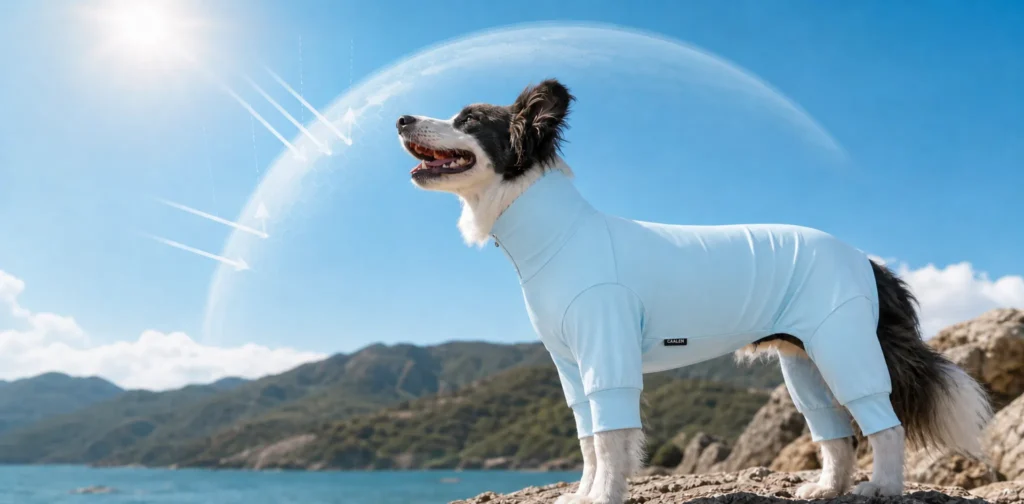
If you’ve shopped for a dog sun suit lately, you’ve probably noticed the same three letters plastered across almost every listing: UPF 50+. It’s become the industry’s go-to badge of trust — printed on product pages, hashtagged on Instagram, stitched onto hang tags.
Here’s the uncomfortable truth: there’s no global mandatory standard for pet sun-protective clothing. Unlike human sun-protective apparel, which in many countries has to meet a recognized testing standard before it can legally claim a UPF rating, pet gear exists in more of a regulatory gray zone. Not every brand publicly shares third-party testing behind that number.
That doesn’t mean every dog sun suit on the market is unverified. It means the burden of verification has quietly shifted onto you, the pet parent.
This guide is about giving you the tools to do that — the same tools we used on ourselves before we ever wrote “UPF 50+” on our own product pages.
Sounds technical? It’s actually pretty simple once you know what to look for.
What UPF Actually Measures
UPF stands for Ultraviolet Protection Factor. It measures how much UV radiation — both UVA and UVB — a fabric blocks before it reaches the skin underneath.
It’s the textile equivalent of SPF, but with one key difference: SPF is a topical rating (how sunscreen performs on skin), while UPF is a structural rating of the fabric itself, based on how light passes — or doesn’t — through the weave.
A compliant fabric under widely used testing frameworks like GB/T 18830-2009 has to clear two thresholds at once:
- UPF must be greater than 40
- Average UVA transmittance must be under 5%
That second number rarely makes it onto marketing pages. But it matters just as much as the UPF figure.
Here’s why: a fabric can post a high UPF number while still letting a meaningful amount of UVA — the wavelength most associated with long-term skin damage — pass through. Real compliance means both boxes are checked, not just one.
Groups like the Skin Cancer Foundation point to sun-protective clothing with a verified UPF rating as one of the more reliable ways to reduce UV exposure — which is exactly why “verified” is the operative word here.
UPF Isn’t Pass/Fail — Here’s What Each Range Actually Blocks
Most marketing treats sun protection like a light switch: either a fabric is “UPF 50+” and therefore safe, or it isn’t. In reality, protection scales gradually, and the jump from “good” to “excellent” is smaller than most price tags suggest.
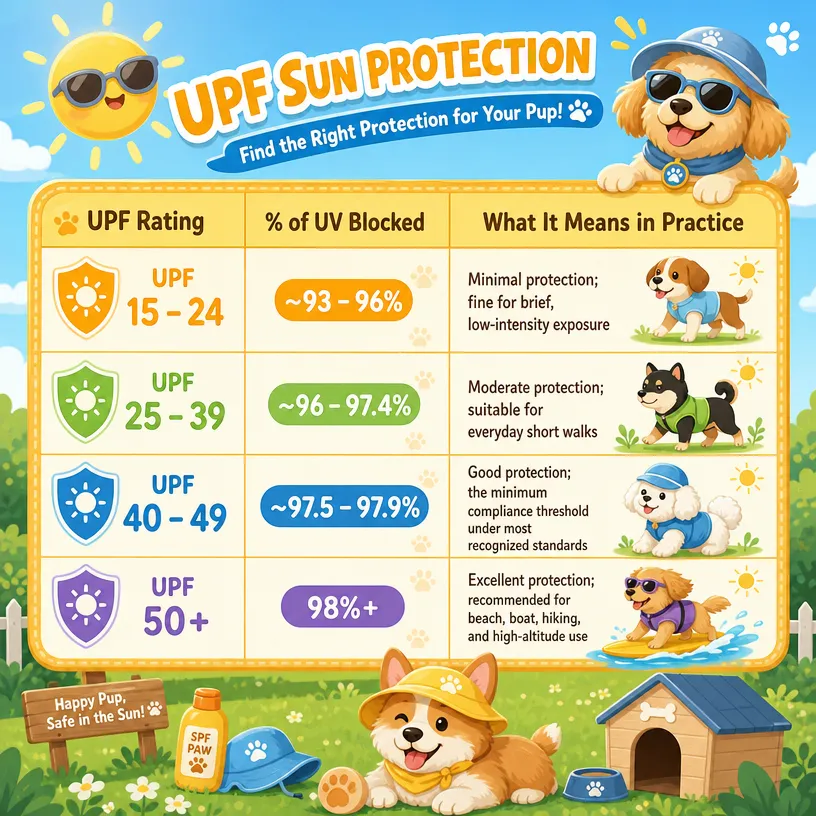
The practical takeaway: once a fabric clears UPF 50, additional gains are marginal.
A product boasting “UPF 100+” or “UPF 500+” isn’t offering meaningfully more protection. It’s offering a bigger number for the same result.
Most recognized testing frameworks don’t even certify above UPF 50+ as a distinct, meaningfully different tier. Treat those inflated numbers as a small red flag, not a selling point.
The Variables That Actually Determine UPF (Not the Ones You’d Guess)
If you’ve read a few sun-protective clothing guides, you’ve probably run into some contradictory advice — one source says darker fabric protects better, another swears by lighter, looser fabric.
Both aren’t wrong exactly. They’re just talking about a secondary variable while skipping the primary one.
1. Weave density matters more than anything else.
A tightly woven, high-density fabric blocks UV far more effectively than a loosely woven one — regardless of color or thickness.
If you remember only one thing from this guide, remember this: density is the foundation. Everything else is a modifier on top of it.
This is why a thin, tightly-knit technical fabric can outperform a thick, loosely-woven cotton tee.
2. Fiber type matters, and not all fabrics are equal.
Synthetic fibers like nylon and polyester generally offer better inherent UV resistance than natural fibers like cotton or linen, because of how they scatter and absorb UV wavelengths at the molecular level.
Untreated linen is a common natural-fiber trap. It feels breathable and “protective” by texture, but its typical UPF rating is often surprisingly low unless it’s specially treated or tightly woven.
Worth keeping in mind if you’ve ever wondered whether shaving your dog down to “let the skin breathe” actually helps in the heat — the coat itself works a lot like a natural fabric layer. We go deeper into that comparison in [why shaving can actually increase sunburn risk]
3. Color is a real factor — but generally speaking, only within the same weave.
Darker colors do generally absorb more UV than lighter ones. But only when comparing two pieces of the same fabric construction.
A loosely-woven black shirt can still have lower UPF than a densely-woven white one. So “dark = safer” is only generally true once density is already equal — the exact nuance most advice leaves out.
If your dog happens to be white or light-coated, this matters even more, since their skin already starts with less natural melanin defense. We cover that combination in more detail in Sun Protection for White & Light-Coated Dogs.
4. Moisture changes everything.
A dry fabric and a wet fabric are not the same fabric, UPF-wise.
Once fibers absorb water, the gaps between them can widen, and UPF can drop by 30–50% depending on the material.
If pool days are part of your dog’s summer, this is exactly why a suit that tests well dry can quietly underperform once it’s soaked — something we get into properly in our upcoming guide on [pool day sun protection and suit care] (link to be added once published).
5. Coating vs. woven-in protection.
This is the one that separates genuinely durable sun protection from short-lived marketing.
Some fabrics achieve their UPF rating through a surface-applied chemical coating — cheap to produce, but the protective layer wears off after a handful of washes.
Others have UV-resistant properties built into the fiber itself during production, which holds up far better over repeated washing.
The finished garment can look identical on day one. The difference only shows up months later — which is really a wash-and-care question more than a shopping-day question. We’ll walk through how to keep a suit performing over time in our upcoming [sun suit care, washing, and storage guide] (link to be added once published).
Three Signs a UPF Claim Might Be Marketing, Not Testing
Based on patterns showing up across pet product listings and buyer complaints, here’s what tends to separate genuine UPF claims from marketing-only ones:
- The claim only exists on the product description page — never on the hang tag, care label, or packaging itself. If a UPF rating disappears the moment you look away from the sales copy, that’s worth noticing.
- Loosely-woven or mesh-heavy fabric marketed as “breathable AND UPF 50+.” Open weaves are, structurally, the opposite of what blocks UV. A fabric can be breathable, or highly UV-resistant through weave density — claiming maximum performance on both without any technical explanation is a pattern worth questioning.
This is also why a single “one suit fits every dog and every season” claim should raise an eyebrow. A flat-faced dog managing heat has genuinely different needs than a sighthound managing thin skin — something we unpack in our upcoming guide on [sun protection for brachycephalic breeds] (link to be added once published).
- No test standard, no report, no lab named — anywhere. A real UPF claim traces back to an actual test, done under an actual standard (GB/T 18830, AATCC 183, and AS/NZS 4399 are among the most commonly referenced), by an accredited lab. If a brand can’t point to any of that when asked, the number on the tag is just a number.
How to Actually Verify a UPF Claim
You don’t need lab equipment for this. You need three questions.
What standard was it tested under? A real answer sounds like a specific standard name, not “we tested it ourselves.”
Can I see the report, or at least the report number? Legitimate brands can produce this. It doesn’t need to be public on the website, but it should exist and be shareable on request.
Is the UVA transmittance mentioned, not just the UPF number? As covered above, this second figure is where a lot of inflated claims quietly fall apart.
Our Own Fabric, Honestly
We’d rather show you exactly what we have than round up.
Our current sun suit fabric was tested under GB/T 18830-2009 by a CNAS-accredited third-party lab, with the following results:
- UPF (average): 126.09
- UVA average transmittance: 4.74% (requirement: under 5%)
- UVB average transmittance: 0.53%
- Result: Pass
That UPF figure is well above the 50+ threshold. Sounds impressive, right? But as covered above, that doesn’t mean it’s meaningfully “better” than a well-made UPF 50+ product. It simply confirms the fabric comfortably clears the bar with margin to spare.
The fabric itself is a nylon-spandex blend, chosen for a combination of density, stretch, and quick-dry performance rather than any single showy spec. We’re intentionally not publishing an exact percentage breakdown here, since composition can shift slightly between production batches and colorways, and we’d rather stay accurate than round to a number that sounds cleaner.
The Bottom Line
A UPF number by itself tells you very little.
What tells you something is whether it’s backed by a named standard, a real lab, and a second figure (UVA transmittance) that most brands never mention.
Once a fabric clears UPF 50 with a passing UVA score, chasing a higher number is chasing marketing, not protection.
And this isn’t just a peak-summer question, either. UV exposure adds up in ways most owners don’t think about until later in the year — part of why we don’t treat sun protection as a June-through-August topic. More on that in our upcoming piece on [why sun protection isn’t just a summer issue] (link to be added once published).
We’d rather you leave this page knowing how to check any brand’s claim — including ours — than simply trust a number on a tag.
If you’re weighing physical coverage against sunscreen in the first place, our earlier breakdown on Dog Sunscreen vs. Sun Suits is a good next read.
Whether you choose our gear or another brand, asking these questions before buying matters more than chasing the highest UPF number on a tag.
If you’d like to see what a fabric that actually passes this test looks and feels like on a dog, [you can browse the current UPF 50+ collection here] — no pressure, just here if you want to look.